
Sic Bo Review
In the 1600s, England played a dice 🎲 game called Hazard, borrowed from Arabic and meaning "the dice."
A couple of hundred years later, Hazard jumped to the Atlantic and was reinvented in New Orleans as craps. The thrill of betting on little dots on cubes has been a casino floor staple ever since.
Sic Bo, another dice-based game, grew on a totally separate branch of that same tree, reaching the West by a completely different route, and Belatra Games built the digital version.
Gameplay
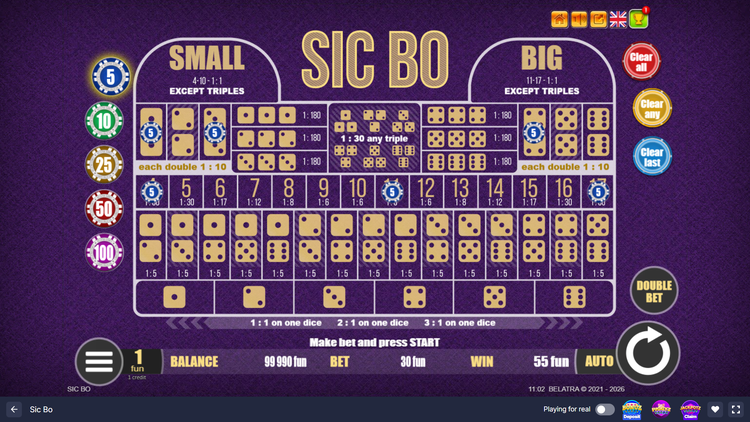
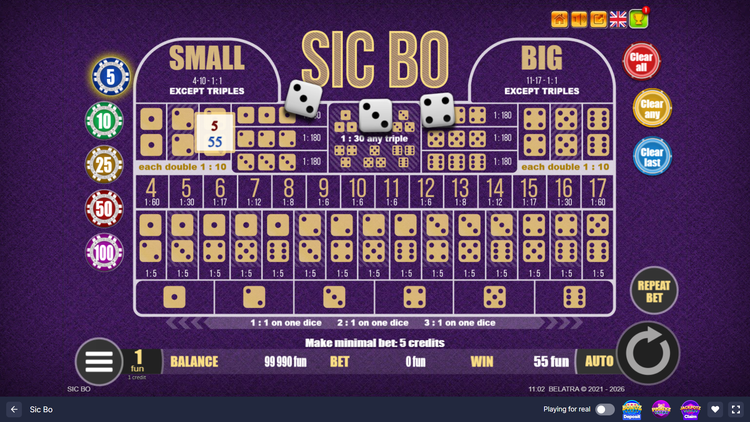
The table doesn't dress itself up. Green, red or deep purple felt, gold lettering, the Small and Big zones at either end, and a grid of numbers and combination bets packed into the middle.
Every completed round ends with 3 dice dropping onto the felt to determine the payouts.
The RTPRTP stands for “Return to Player.” The RTP describes the total bet amount that a game returns to players over millions of spins, and that figure is represented by a percentage. Table games, such as Roulette, typically have higher RTPs than many slots.
RTP needs to be considered in conjunction with a game’s volatility rate. ranges from 81.02% to 97.22% depending on which bet you place, the volatility is medium, the max multiplier is 180x, and the max win comes in at $90,000.
Bets start at $1 on the entry-level table and top out at $500 on the highest tier. You get 3 table tiers to choose from before each round, and the limits scale together across every bet type.
Big and Small are the safest bets on the table, each paying 1:1. Big covers any total from 11 to 17, Small covers 4 to 10, and both of them lose automatically if the dice land on a triple.
A Three Dice Total bet backs a specific sum, and the payout tracks how hard that sum is to make: 4 or 17 pays 60:1, 5 or 16 pays 30:1, 6 or 15 pays 17:1, 7 or 14 pays 12:1, 8 or 13 pays 8:1, and every total from 9 through 12 pays 6:1.
Any Triple pays 30:1 when any of the 6 possible triples shows up. A Specific Triple, where you name the exact number and need all 3 dice to land on it, pays 180:1, the biggest payout anywhere on the grid.
A Specific Double asks for a single number on at least 2 of the 3 dice and pays 10:1. A Dice Combinations bet wants 2 different specific numbers among the 3 dice and pays 5:1.
A Single Dice Bet backs one number to appear on 1, 2, or all 3 dice, paying 1:1, 2:1, or 3:1 depending on how many times that number lands.
Five chip denominations sit on the felt, scaled to whichever table tier you're playing.
The "Clear All," "Clear Any," and "Clear Last" buttons reset a bet, and a fourth button flips between "Double Bet" and "Repeat Bet" depending on whether you've got a wager down.
Features
There are no features here, and Sic Bo doesn't pretend otherwise. The bet grid is the entire game, so everything listed above in Gameplay is all of it.
A settings menu lets you adjust turbo mode and switch which table you're playing on, but neither one moves the odds by a fraction.
Performance
I ran an extended session and didn't hit a single issue, with the dice animation and the payout settlement landing instantly every round.
Maximum Win
The max win is $90,000, and it takes the 180x max multiplier at the top bet of $500. The smallest bet is $1.
Conclusion
The game's biggest number comes from one bet: the Specific Triple, where you name a single exact number and watch all 3 dice land on it for 180:1.
The true odds against that are 1 in 216, so the 180:1 payout sits well short of the math. Hitting it on any given round is closer to a lottery ticket than a plan you can build a session around.
The RTPRTP stands for “Return to Player.” The RTP describes the total bet amount that a game returns to players over millions of spins, and that figure is represented by a percentage. Table games, such as Roulette, typically have higher RTPs than many slots.
RTP needs to be considered in conjunction with a game’s volatility rate. swings from 81.02% up to 97.22%, which is an unusually wide spread because the number isn't fixed the way it is on most games. It moves with the bet you pick, so you're the one setting it.
Stick to Big or Small and you're sitting near the top of that range, which supports a much longer session. Chase the Specific Triple or Any Triple and the RTPRTP stands for “Return to Player.” The RTP describes the total bet amount that a game returns to players over millions of spins, and that figure is represented by a percentage. Table games, such as Roulette, typically have higher RTPs than many slots.
RTP needs to be considered in conjunction with a game’s volatility rate. slides toward 81.02%, which burns through a bankroll faster.
The card rates volatility as medium, but that one word covers a lot of ground. Big and Small play close to a coin flip, while the Specific Triple and Any Triple bets swing far harder than a medium rating suggests.
There's no Ante BetAn Ante Bet is an option that costs a percentage of your bet but increases your chances of landing triggering symbols that initiate a feature. and no Buy Bonus, so there's nothing to buy and nothing to boost. Every result comes straight off the dice, which is either refreshing or maddening depending on how patient you are.
Cautious players with a smaller bankroll suit the Small and Big bets best, where the near-even odds make for a longer, steadier session, and they should skip the long shots entirely.
Bigger-bankroll players hunting one large hit should do the opposite: skip the even-money bets, sit on the Specific Triple or Any Triple, and accept that most rounds return nothing in exchange for a shot at 180:1.
Slot Details
Game Provider: Belatra Games
Game Type: Video Slots
PaylinesPaylines are preset lines that run across the reels, and when you land matching symbols on them, that will result in a payout. The more paylines, the more ways you can win, but also the higher your bet per spin.: N/A
RTPRTP stands for “Return to Player.” The RTP describes the total bet amount that a game returns to players over millions of spins, and that figure is represented by a percentage. Table games, such as Roulette, typically have higher RTPs than many slots.
RTP needs to be considered in conjunction with a game’s volatility rate.: 81.02%-97.22%
Volatility RateSlot games can have low, medium, high, or extremely high volatility rates (or a combination thereof).
The less volatile the game, the more often it should pay out, but the lower the amount, the less the payout, as this is in keeping with the risk you’re taking. Volatility rate should be considered in conjunction with a game’s RTP.: Medium
Bonus Round: No
Progressive: No
Free Rounds: No
Max Multiplier: 180x
Max Win: $90,000
Published by
BitStarz, award-winning Bitcoin Casino